A Life on Facebook
This came streaming across my Facebook newsfeed, and I thought it worth of a share. Apprently life on Facebook involves many visits to Las Vegas, and when that life is over? Well… we “logout.”

This came streaming across my Facebook newsfeed, and I thought it worth of a share. Apprently life on Facebook involves many visits to Las Vegas, and when that life is over? Well… we “logout.”
 Last week on Mashable, I read a blog post stating, “Facebook is doing its very best not to make you terribly sad.”
I expect you have noticed the new “Photo Memories” box that appear in the upper right-hand side of Facebook’s interface — basically a photo including you and one of your friends. Although I rarely click on them, I kind of like the addition. I had not, however, realized that this addition might be making scores of Facebook users depressed by showing them painful photos including their exs.
So Facebook has fixed this, and its all well and good. But it did give me chuckle given my propensity to rant about attempts to turn our social lives into algorithms.
The day before I read this post, I gave a lecture on “Remembering, Forgetting and the Challenges of Representing Humans” in Social Implications of Information Systems. During this lecture I talked to students about the ways in which the design of a site like Facebook can help us share details from our lives, but in doing so it also restrains what can be shared. When talking about Facebook’s Relationship Status I made the point that a drop-down box of values is probably too limited to capture the full range of our relationship experiences (something I have blogged about before).
One of my students explained that even when we do use the system Facebook designs, sometimes the information we provide is an outright lie. On her Facebook profile, apparently, she is married to her “best gay friend.”
So back to the photos. It’s great that Facebook is no longer making people depressed. Also, I kind of like the new feature. But it seems that Facebook is once again relying on the data people provide in ways that might be problematic. After all, I suspect my student will eventually meet the man of her dreams, and when the time is right they’ll update their Facebook and let the world know. However, this also means she’ll have to break up with her best friend, and Facebook will no longer remind them of the fun times they have had over the years.
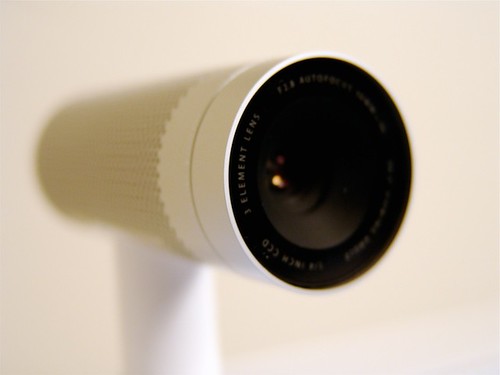
“Why do we feel like we need to keep visiting the archetype over and over and over again?” asks Karim Rashid, a New York designer. The camera, for example, which since digital photography’s complete obliteration of film has absolutely no reason to remain a metal rectangle.
Flying back from Chicago last night (and admittedly procrastinating a certain final paper), I threw open on of my favorite archetypes (the laptop) and watched the documentary Objectified. I had missed the chance to see it when it was screened at the Corcoran last summer (tickets were scarce, even for Steve) but decided to make up for lost time. (more…)
I have a strange habit. When things get really stressful, I start fantasying that I am somewhere else. This is nothing unique, but in my case, studying technologies that actually allow people to be somewhere else, it expresses itself in slightly strange ways.
When writing the literature review for my thesis, for example, and having spent so much time researching virtual communities, I decided that I should do more than read about them — I should live in one too! And so off I went to LambdaMOO, one of the most famous text-based virtual communities.

Sitting in my DC condo, I would slide my LambdaMOO existence off to one of my screens, while continuing to typing away in Word. A quick glance to the terminal with its black screen and white text was enough to remind me that somewhere else, some portion of me wasn’t enduring the pain of writing a thesis. This worked, kind of, but not for very long. (more…)
A couple links for your Friday fun. Some new, others fall under the “in case you missed it.”
From the “technology is so cool” department: 10/GUI
Dear mouse, you suck. Monitor, you too. See what happens when one goes about “rethinking the desktop to leverage [new] technology in an intuitive and powerful way.”
From the “let’s create an infrastructure no one needs” department: Project ‘Gaydar’
At MIT, an experiment identifies which students are gay, raising new questions about online privacy.
From the “Jed just really likes flash mobs” department: Madonna Celebration flash mob in Shinjuku, Tokyo
I particularly love the ballet girl at around 1:50. For CCTers out there — musicals and utopia? I think so. For Megan, who says networks are “unhuman”? 
(via Towleroad, and omg, I just found another — in case you want to know what one look like when a drag queen takes control.)
And just because I am running around at UCI Medical Center this morning: Computer detects abuse before doctors
Victims of domestic abuse can hide the truth from doctors, but they leave clues in their medical records that a computer program has now learned to follow. The program could save lives by acting as an early warning system for domestic violence, flagging up possible cases of abuse to doctors months or even years before they would otherwise be detected.
 There is a debate at work right now. Granted, it is a bit ideological, but it is one of those classic web developer debates we feel compelled to return to every couple of years:
Should we expect our users to have JavaScript enabled?
Perhaps more importantly, what should we do when they don’t?
Ever since Google Maps ripped open the possibilities of web-based development (with turn-by-turn directions no less), we have been stuck with this bizarre requirement: JavaScript. Sure, it makes the web go round, but I still have nightmares of trying to get the University of Utah labs to upgrade to Flash v7, and our web analytics show a stunningly high level of Netscape v4.

So you’re writing a thesis, and you are stressed out of your mind, and you think you can’t write one more word. What do you do? You write a magazine article!
This news can be filed under “didn’t tell you about this because of my thesis”, but earlier this year Brett Harris and I wrote an article for the first issue of the new JavaScript Magazine.
ExtJS: An Introduction (the article we wrote), is a technical examination of this JavaScript framework, and how Ext, and frameworks like it, can make your code and your life awesome.
It is cheap to buy an issue online, so if you have been looking for a way to approach these big scary frameworks, it’s worth checking out.

Next Wednesday, craigslist founder Craig Newmark will be visiting Georgetown University. Given that my thesis examines craigslist extensively (with a particular focus on Missed Connections, of course), I have been given an incredible opportunity to interview Mr. Newmark. I am currently compiling a list of questions, but I wanted to let you do the same:
Leave it in the comments, or twitter me. If the question is good, I am happy to get you an answer.
Update: For more information on the lecture, check out the event on Facebook. It is open to everyone, so if you are local, free up your calendar and come!
 A new book has just been released by cartoonist Julia Wertz, entitled “I Saw You…: Comics Inspired by Real-Life Missed Connections“. Wertz gathered up some favorite Missed Connections and handed them to some of her favorite artists in order to give life to the anonymous posts anxiously hoping to be discovered online.
According to the NYT:
Ms. Wertz writes that she started reading Missed Connections not because she wanted to post an ad herself (oh yeah?) but because she was “intrigued” by the idea of “a subculture of people who feel they missed something great because they didn’t have the courage to speak up.”
I have always felt lucky studying Missed Connections. They are stories that tell themselves, and so I can only imagine how beautifully they must turn out once illustrated. Besides, this way I can justify reading some comics for my academic research! I have One-Clicked it, and will let you know how it is once it arrives next week.
(Thanks Barbara for the heads up!)